Activity & frailty: a daily movement signal you can track.
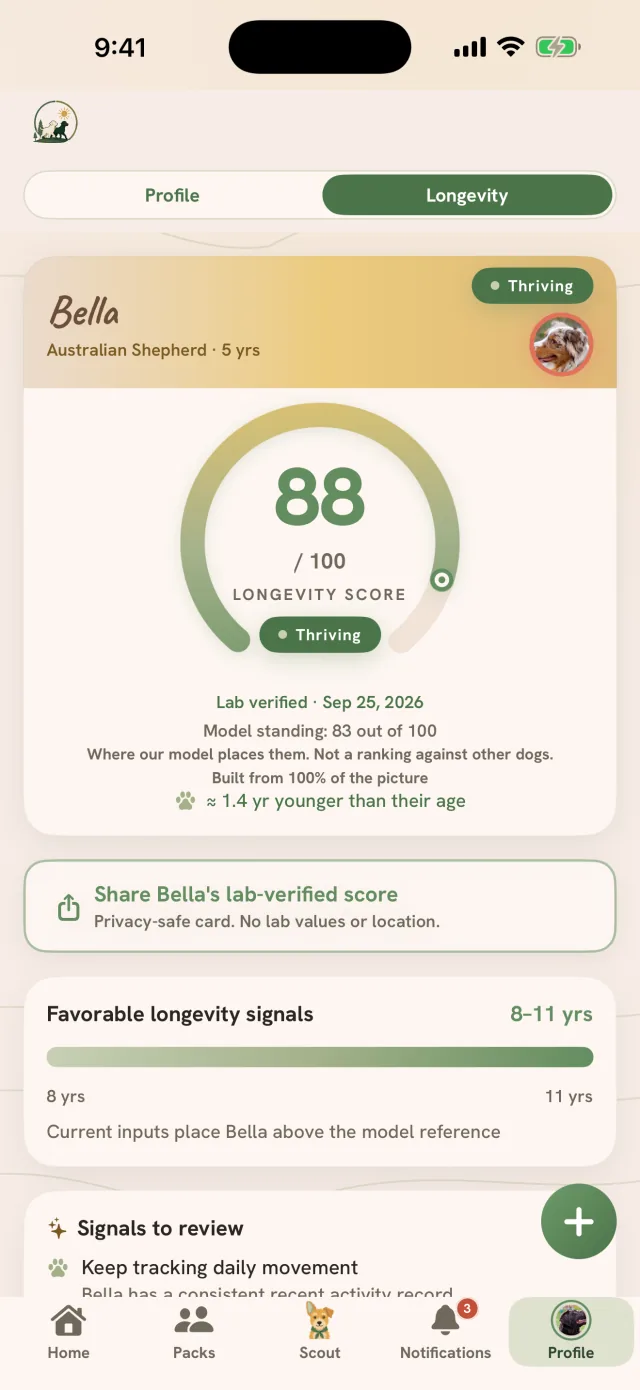
This is the movement bar in your dog’s longevity score: the steady, everyday activity built from the walks you already log, and, once your vet measures it, the frailty phenotype, the strongest evidence in this bar. It’s the one component you move every single day.

One of the four bars behind the score. Free to play, educational and non-diagnostic.
Movement, mobility, and the frailty phenotype
Activity is the steady movement that keeps muscle, joints, heart, and mind in good shape: daily walks, play, sniff-time, and the gentle wear-and-tear that keeps an older dog mobile. It helps hold a healthy weight and slows the frailty that tends to creep in with age. Even short, consistent walks add up across the years.
One of the four bars you read at a glance
Activity is the amber bar: the lever you move every day, next to the fixed Genetics baseline, the Body-condition lever, and the vet-locked Bloodwork bar. It opens to its own drivers, so nothing about it is a black box.
One honest signal, one grade-A read
This bar deliberately holds two very different things. In the Estimate, it’s the activity you log: a soft, capped signal. In the lab verified tier, your vet adds a frailty read that’s strong enough to move the whole score.
Informational wellness guidance, not a diagnosis. Talk with your vet about what’s right for your dog.
What actually feeds the Activity dimension
Under the hood this is dimension D3: Activity & Frailty. Here’s the same card your dog gets, with the inputs and how it moves the score.
Frailty: the grade-A read
In Verified, your vet scores a frailty index: the fraction of assessed domains that are impaired. Six-month mortality hazard climbs with it: ≈9× at 0.2 to 0.4, ≈18× above 0.4, and a ≥3-domain phenotype flags a high-mortality state (HR ≈ 4.71) that takes years off this dimension and lowers the model-implied standing. It doesn’t widen the range (a missing component does that; a vet-measured one tightens it), and it’s surfaced to your vet, never a diagnosis.
Why one half is strong and the other stays humble
Every part of the score carries its evidence grade: A for large cohort or cross-species mortality data down to C for mechanistic or extrapolated signals. Activity and frailty land at opposite ends, and we treat them accordingly rather than averaging the difference away.
The honest caveat. The frailty evidence is adjusted evidence: Russell 2024 reports its six-month mortality hazard ratio after adjusting for age, sex, and weight, so the association is not just age wearing a different name. Activity can’t make that claim, so it doesn’t.
Small, steady moves that add good days
The app surfaces these right on the Activity card: concrete, friendly steps, not a training plan. Because this is the easiest lever, the wins compound quietly across the years.
Build up slowly for older or heavier dogs, and let joints set the pace. Informational wellness guidance, not a diagnosis.
Please read
The short version: Tailmates is a wellness and fitness product, not a medical device and not a veterinary provider. The Activity & frailty component is educational and non-diagnostic. The score it feeds is expressed as a range, never a single date, and it does not diagnose, treat, cure, or prevent any disease. A frailty read is surfaced to your veterinarian. It is not a diagnosis, and it is not a substitute for examination or treatment by a licensed vet.
If your dog is unwell, contact a veterinarian or an emergency clinic. Do not wait on, or rely on, an app score.
A daily movement signal you can track.
Turn today’s walk into a trackable habit
The Estimate unlocks at Level 10, free, and every walk you log moves the Activity bar. Review it with your vet whenever you’re ready.