The baseline you were dealt, and why it’s not your fault.
Genetics is your dog’s inherited rate of aging: breed, body size, and build, read against life tables built from millions of dogs. It’s the one bar you can’t change, so we show it plainly and kindly. It’s a starting line, not a verdict, and always a range, never a date.
One of the four longevity components. The Estimate unlocks at Level 10, free. Educational and non-diagnostic.
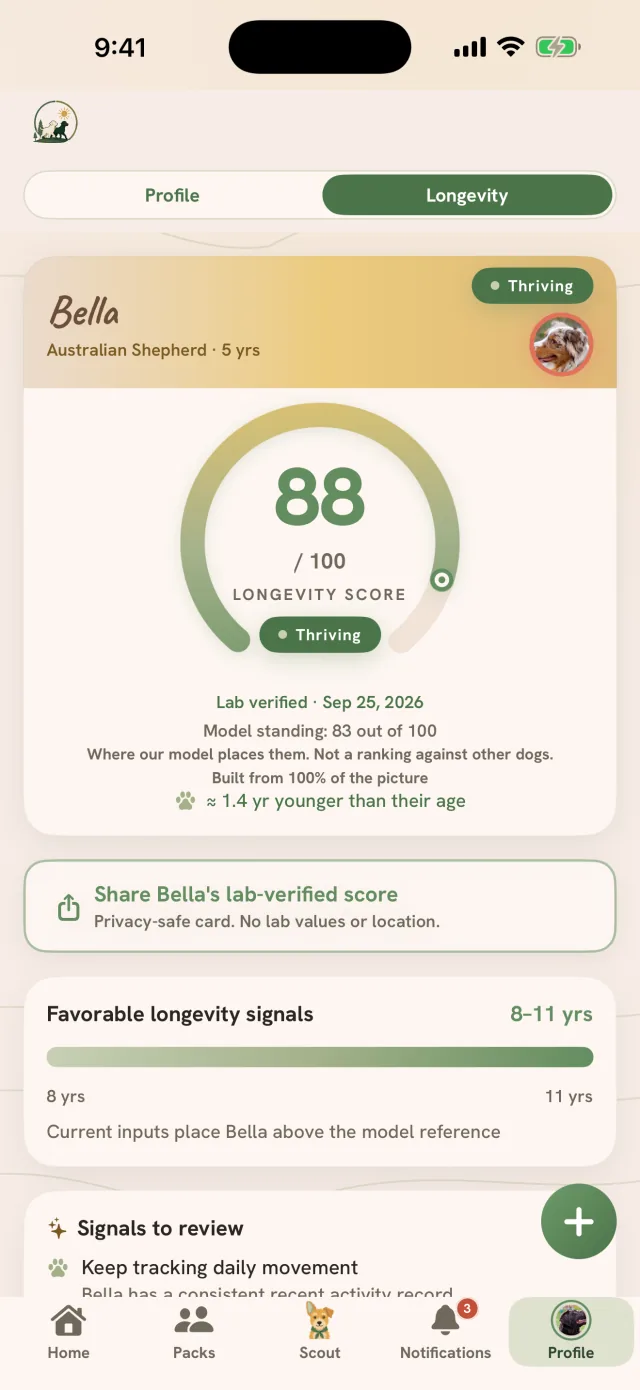
The hand your dog was dealt
Genetics is framed as fixed, not blamed. A shorter breed baseline isn’t something you did; it just means the levers you do control (weight, movement, and a lab-verified blood panel) matter even more. This bar is a context, never a countdown.
Four inputs, all from what you already know
No DNA test required. The genetic baseline is built from signalment (breed, size, age, neuter status) and an optional genetics panel that sharpens it if you have one. Every input carries an evidence grade.
Evidence-graded: A = large cohort / cross-species mortality data · B = disease-cohort survival · C = mechanistic or extrapolated.
Mostly in the baseline: the smallest separate weight
Here’s the honest, glass-box part: genetics matters enormously, yet it carries the smallest score weight of any dimension. That’s not a contradiction. It’s because breed and size are already baked into the actuarial baseline that anchors the whole estimate.
Putting a big separate genetics penalty on top would be double-counting the same signal. So the Genetic dimension carries a small weight (about 0.04), and its own extra adjustment is near-zero by construction. The genetics story lives inside the baseline, not in a second charge against it.
How the baseline is assembled
It’s a glass box. Here’s the plain-language version of the math that turns your dog’s signalment into a life-expectancy range.
D1: Genetic & Constitutional
Inside the score, genetics is the first of seven clinical dimensions. Here’s the same card your vet reads, with the real markers, an illustrative sample read, and its evidence grade.
Evidence grade A (size→lifespan, breed LE) · C (variant-level deltas)
You can’t change genetics, but you can play the hand well
Genetics is the one bar with no “ways to improve” list, because it’s fixed. And that’s the point. What you can do is aim your effort at the bars that move: the harder the genetic hand, the more the modifiable levers matter.
- Body condition: A well-studied body-condition signal. Tailmates uses a hand-set prior, not an individual intervention effect.
- Activity: A daily movement signal you can track. Logged activity is a bounded input, not evidence that a walk changed lifespan.
- Bloodwork: Your dog's inside story, lab verified. Catches quiet organ shifts early, and unlocks the lab-verified score with your vet in the loop.
Straight answers about the baseline
Please read
The short version: Tailmates is a wellness and fitness product, not a medical device and not a veterinary provider. The genetic baseline, like the whole Longevity Estimate, is educational and non-diagnostic. It is expressed as a range, never a single date, and it does not diagnose, treat, cure, or prevent any disease. It is not a substitute for examination, diagnosis, or treatment by a licensed veterinarian.
Meet the hand your dog was dealt.
See your dog’s genetic baseline
The Estimate unlocks at Level 10, free, with no DNA test required. Review it with your vet whenever you’re ready.