Back to the longevity score
Longevity · Body condition

A well-studied body-condition signal.

Body condition is how lean or heavy your dog is for their frame, and, of the four things that make up the longevity score, it’s the one your daily choices move the most. Keeping weight in the ideal range is one of the most consistently studied longevity levers in dogs, and Tailmates shows it as a range, never a date.

Free to play. This bar unlocks the moment you add your dog. Educational and non-diagnostic.

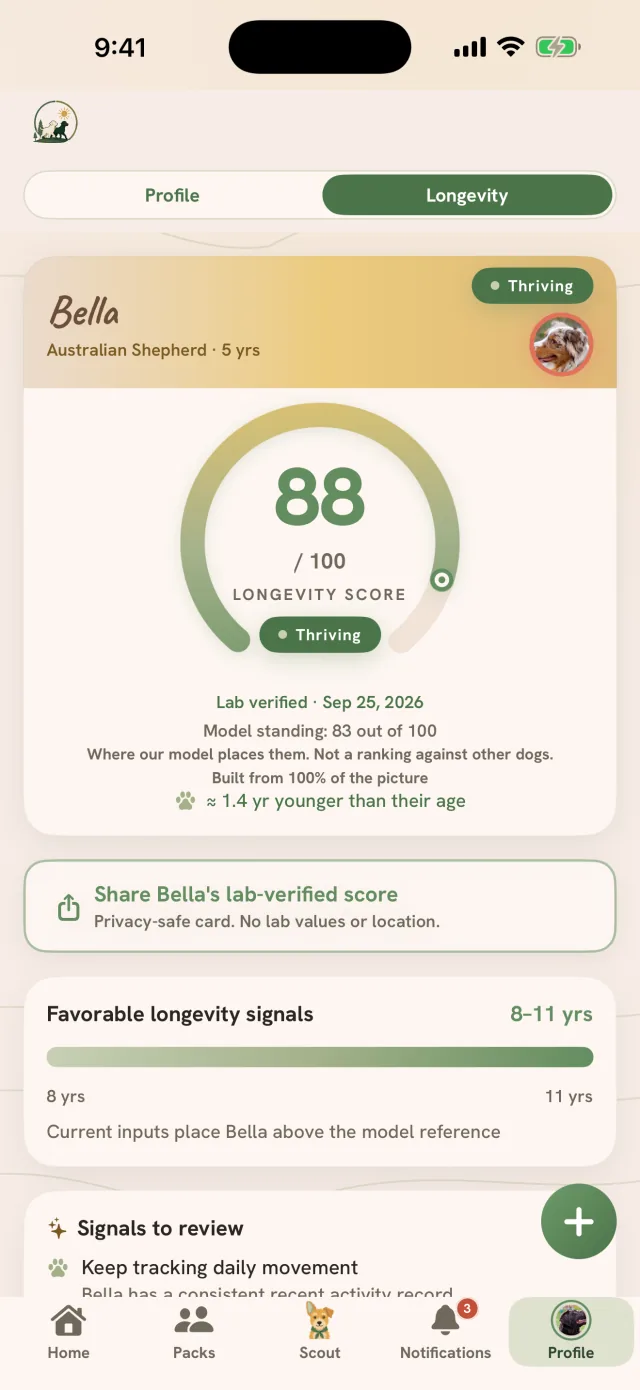
The Tailmates longevity screen: the four owner bars, with Body condition among the levers you move every day.

In one line

A well-studied body-condition signal

What it is

Body condition is how lean or heavy your dog is for their frame. Vets score it on a 9-point scale where ribs are easy to feel but not see. It's a better read than the number on the scale because it accounts for breed and build.

Why it matters for longevity

Lean body condition is associated with better mobility and, in controlled feeding research, longer survival than overweight body condition. Tailmates does not estimate how many years a weight change would add for an individual dog.

Body condition bar

You move this
Body condition86
  • +Ideal body condition (5/9)
  • +Steady healthy weight
  • -Slight winter gain to watch

Illustrative. One of four owner bars: the movable lever, shown with its top drivers.

Weight in the score · 0.18

Body condition carries the second-highest weight of the seven dimensions, behind only the kidneys. It’s a grade-A signal, and unlike genetics, it’s one you can actually change.

The read, not the scale

How vets read body condition, 1 to 9

The sub-score peaks at the ideal band and falls off symmetrically: the current rule set lowers its body-condition subscore at both extremes. Here’s the same 9-point scale your vet uses, in plain English.

123456789Ideal · 4–5ribs easy to feel · visible waist · tummy tuckToo leanToo heavy
BCS 1–3

Under-weight

Ribs, spine, and hips stand out; little fat cover. A modest signal, worth a vet conversation.

BCS 4–5

Ideal

Ribs easy to feel, a visible waist from above, a tuck from the side. The healthy-weight target.

BCS 6–7

Over-weight

Ribs harder to feel, waist fading. Breed-scaled cost: small breeds carry it heavier.

BCS 8–9

Obese

Ribs hard to find under fat, no waist. The heaviest lifespan cost of the four bands.

Educational. Your dog’s body-condition read is best done with, or read by, your vet, who can set an ideal-weight target for your dog’s breed and frame.

The dimension, in depth

What the score actually reads, and how much it moves

This is dimension D2 in the glass-box decomposition. Real inputs, a grade-A evidence base, and published effect sizes translated into numbers we state plainly. What a study found and what our model applies are two different things, so we show you both.

Sample
D2

Body Composition

second-highest weight · 0.18

What it means. How lean or heavy your dog is for their frame, scored the way a vet reads body condition (ribs easy to feel, a visible waist), not just the number on the scale.

Why it matters. Body condition has unusually strong canine evidence for this framework. A controlled feeding trial found a group-level survival difference under its specific protocol, while observational studies associate adiposity with shorter survival. Tailmates applies a smaller hand-set prior; it does not estimate how many years changing an individual dog's weight would add.

BCS 5 / 9 · idealOptimal

Body condition score (1–9) · Weight trend

Evidence grade A · every number shown is a SAMPLE. Your dog’s read comes from you and your vet.

The evidence, graded and honest

Body composition is one of the few dimensions with grade-A evidence behind it, including a controlled feeding trial. Each band below shows the published finding and, separately, the number our model applies. The dimension weight then scales ours again: in the free Estimate, body condition carries half the weight, so an ideal read lands at about +0.25 years, informational, never a promise.

Ideal · BCS 4–5

+0.5 yr in this dimension

What the study found

Kealy 2002: Labradors fed to stay lean lived about 1.8 years longer than their heavier littermates.

What our model applies

That trial anchors the band. Its number is not our number. Tailmates models ideal body condition at +0.5 years inside this dimension, and the dimension weight scales it down from there.

Evidence grade A

Over-weight · BCS 6–7

−0.6 to −1.1 yr

What the study found

Salt 2019, 12 breeds: overweight dogs lived shorter lives, and smaller breeds paid the steeper cost.

What our model applies

We take the shape, not the headline. The model reads −0.8 years, scaled by breed size, so a toy lands near −1.1 and a giant near −0.6.

Evidence grade A

Obese · BCS 8–9

−1.1 to −2.0 yr

What the study found

Montoya 2023 life tables: obese dogs sit near 11.7 years where ideal dogs sit near 13.2, a gap of about 1.5 years.

What our model applies

The heaviest band, scaled by breed size the same way. It is the largest single cost in the model that an owner can change.

Evidence grade A

Under-weight · BCS 1–3

−0.3 yr

What the study found

Population data links underweight to modest excess risk. Lower confidence than the other three bands.

What our model applies

A small cost on purpose. Too lean has its own price, and it's a reason to check in with your vet.

Evidence grade B

How grades work. A = large-cohort or controlled data · B = disease-cohort survival. The over-weight penalty is breed-size scaled, smaller breeds tend to pay a steeper cost, so the score never applies a flat number.

Ways to help

Small, steady changes move this bar

Because body condition is the most changeable input in the whole score, it’s where a little consistency goes the furthest. These are the same in-app tips Tailmates surfaces on the Body Condition card, practical, not preachy.

The ribs-and-waist check

Run a flat hand over the ribs: you want to feel them easily, like the back of your knuckles, without pressing. Look from above for a waist, and from the side for a tummy tuck. That’s the ideal band, no scale required.

  • 1
    Measure meals with a cup or scale instead of eyeballing the bowl
  • 2
    Swap a portion of treats for training kibble or veggies
  • 3
    Run the ribs-and-waist check weekly: you want to feel ribs without pressing
  • 4
    Ask your vet for an ideal-weight target for your dog's breed and frame
  • Informational wellness guidance, not a diagnosis. Talk with your vet about what’s right for your dog, especially before a big change in food or exercise.
One of four bars

Body condition is the lever. Here’s the whole picture.

Genetics is the fixed hand your dog was dealt; body condition and activity are the levers you move every day; bloodwork is the inside story your vet unlocks. Together they make the longevity score, always a range, never a date.

Longevity Estimate

On Track
Genetics72
Body condition86
Activity64
BloodworkUnlock with your vet

Illustrative. Bloodwork stays locked until your vet reviews the panel.

Questions, answered

Straight answers about body condition

Is a body-condition score a diagnosis?
No. Body condition is an educational wellness read, not a medical test or diagnosis. It does not detect disease or estimate the causal lifespan effect of changing weight. Unexpected weight change is a reason to consult your veterinarian.
Why the 9-point scale instead of just the number on the scale?
Because weight alone can't tell a lean Greyhound from a heavy Beagle. The body-condition scale reads the actual body: ribs easy to feel, a visible waist, a tummy tuck, so it accounts for breed and build the way a vet does. It's the standard clinicians use.
How much does body condition really move the score?
The current rule set gives body condition the second-highest dimension weight and assigns an ideal observation a positive model contribution. Those years-like coefficients are hand-set accounting terms, not individualized treatment effects. A controlled Labrador feeding study found a survival difference between feeding groups, but Tailmates does not transfer that number to an individual dog.
My dog is a little overweight. Is it too late?
Body condition is one of the most changeable inputs in the whole score, which is exactly why it's the biggest owner-controlled lever. Small, steady changes to portions and treats move it, and your vet can set a realistic ideal-weight target for your dog's breed and frame. This bar rewards the direction you're heading, not just today's number.

Please read

The short version: Tailmates is a wellness and fitness product, not a medical device and not a veterinary provider. Body condition is educational and non-diagnostic, it’s expressed as part of a score shown as a range, never a single date, and it does not diagnose, treat, cure, or prevent any disease. It is not a substitute for examination, diagnosis, or treatment by a licensed veterinarian.

If your dog is unwell or losing or gaining weight unexpectedly, contact a veterinarian. Don’t wait on, or rely on, an app score.

Pull the lever you actually control.

Start your dog’s Longevity Estimate

Free to play. The Estimate unlocks the moment you add your dog, and body condition is a bar you can move from day one.