Longevity · Bloodwork

Your dog’s inside story, lab verified.

Bloodwork is a snapshot of how your dog’s organs are doing on the inside, long before anything shows on the outside: kidneys, liver, thyroid, metabolism, and blood cells. It’s the part of the picture you can’t see on a walk, and the one bar that stays locked until a real panel is lab verified and your vet is in the loop. That review is what lets Tailmates turn an Estimate into a lab-verified score.

One of the four inputs to the longevity score. Educational and non-diagnostic: always a range, never a date.
The Tailmates longevity screen: the four owner bars with Bloodwork shown locked until a vet reviews the panel.
In one line

The inside story that early, informed care is built on

What it measures. A blood panel reads how your dog’s organs are working from the inside: kidney and liver function, metabolic and thyroid balance, and the blood cells that show how the body defends and repairs itself. It sees shifts long before anything changes on a walk.

Why it matters for lifespan. A shift in kidney, liver, thyroid, or metabolic markers can give your veterinarian useful clinical context. The score’s organ weights are hand-set literature priors, not fitted estimates of lifespan effect, and they require prospective validation.

Longevity Estimate

On Track
Genetics72
Body condition86
Activity64
BloodworkUnlock with your vet

Illustrative. Bloodwork is the fourth bar, locked until your vet reviews the panel.

Under the Bloodwork bar

Seven clinical dimensions your vet reads

Unlocking Bloodwork opens the organ-system decomposition your vet reads: each dimension scored against optimal ranges, not just “in-range or out.” Here’s what each one captures, the real markers behind it, and how the app frames a sample read.

Sample

Every number below is a sample: illustrative, not a real result. Your dog’s numbers come from your vet’s blood panel.

Evidence-graded: A = large cohort or cross-species mortality data · B = disease-cohort survival · C = mechanistic or extrapolated. Weaker markers are flagged and near-zero-weighted.

Sample
Kidney

Kidney Function

highest weight · 0.24

What it means. How the kidneys are filtering, read from SDMA, creatinine, BUN, and phosphorus. SDMA rises after about 40% of kidney function is lost, while creatinine waits until roughly 75%, so it's the earliest read we have.

Why it matters. Kidney markers provide clinically useful information about renal function, but no single organ is a validated master axis of canine aging. Tailmates gives this block a hand-set weight that must be tested prospectively.

SDMA 9 µg/dLOptimal

SDMA · Creatinine · BUN · Phosphorus

Evidence grade A / B

Sample
Liver

Liver & Hepatobiliary

What it means. Liver function plus the protein and nutrition picture: ALT, ALP, and GGT for the liver, and albumin, globulin, and the albumin-to-globulin ratio for the quiet inflamm-aging axis that tracks with resilient aging.

Why it matters. A falling A:G ratio, meaning albumin down and globulin up, is one of the better-evidenced aging markers, and GGT above about 25 U/L carries the highest hazard for two-year death in hepatobiliary disease. Drifting enzymes flag issues while they're still easy to support.

ALT 58 U/LOptimal

ALT · ALP · GGT · Albumin · Globulin · A:G

Evidence grade A · B

Sample
Metabolic

Metabolic & Glucose

What it means. The energy systems: glucose and fructosamine, plus cholesterol and triglycerides. Fructosamine reads two to three weeks of glycemic control, which is steadier than a single glucose draw.

Why it matters. An honest caveat lives here: unlike in people, glucose and cholesterol don't track aging in dogs, so this dimension is deliberately down-weighted for the longevity score even though diabetes and glycemic issues matter clinically. A value drifting toward the edge of range is a conversation to have with your vet early.

Glucose 112 mg/dLWatch

Glucose · Fructosamine · Cholesterol · Triglycerides

Evidence grade B / C

Sample
Thyroid

Thyroid & Endocrine

What it means. The hormone systems that set your dog's metabolic pace: total T4 and TSH for thyroid, and calcium for the endocrine picture. A low T4 can mean true hypothyroidism, or simply that a dog is unwell; free T4 disambiguates.

Why it matters. Thyroid and adrenal shifts shape weight, coat, energy, and long-term risk, and they're eminently treatable when caught. These are surfaced to your vet with an honest, careful weight in the longevity score rather than overclaimed.

T4 1.8 µg/dLOptimal

Total T4 · TSH · Calcium

Evidence grade B

Sample
Inflammation

Inflammation & Immune (CBC)

What it means. Systemic inflammation and oxygen-transport reserve from the complete blood count: the neutrophil-to-lymphocyte ratio (computed, not just binned), WBC and CRP, and the red-cell markers of anemia (hematocrit, hemoglobin, and RDW).

Why it matters. Low-grade inflammation is a throughline in aging across species, and anemia is an independent mortality predictor. Inflammation is modeled as a shared upstream node that gently modulates the other organ systems: counted once, never charged twice.

WBC 8.4 ×10³/µLOptimal

WBC · NLR · CRP · Hematocrit · Hgb · RDW

Evidence grade A / B · C

Sample
Cardiac

Cardiac

What it means. The heart-strain markers a full panel can add, NT-proBNP and troponin, that read cardiac stretch and injury before a murmur or a cough tells the story on the outside.

Why it matters. A rising NT-proBNP is an early, quiet flag that gives your vet a reason to look closer with an exam or imaging while there's still runway. It's surfaced to your vet and weighted carefully, never treated as a home diagnosis.

NT-proBNP 720 pmol/LWatch

NT-proBNP · Troponin

Evidence grade B

Sample
Hydration

Hydration & Electrolytes

What it means. The salt-and-water balance a chemistry panel reports, which keeps nerves, muscles, and the kidneys working in concert: sodium, potassium, chloride, and calcium.

Why it matters. Electrolytes are the body's fine print: a value out of its narrow band can point toward kidney, adrenal, or hydration changes worth a closer look. It rounds out the panel your vet reads and helps put the other dimensions in context.

Na⁺ 146 mmol/LOptimal

Sodium · Potassium · Chloride · Calcium

Evidence grade B / C

Within each dimension, collinear markers (SDMA, creatinine, and BUN all read the kidney) auto-downweight so the score never triple-counts the same signal, and inflammation is modeled once, as a shared upstream node. It’s a glass box: every read shows the optimal-vs-current gap, not just a pass or fail.

Estimate → Lab-verified

Locked in the Estimate. Unlocked when the panel is lab verified.

Genetics, body condition, and activity give you three instant, free bars. Bloodwork is the fourth, and it stays locked on purpose, because a lab-verified score has to be earned by a real panel, lab verified with your vet in the loop.

Estimate

Free · instant

Three bars the moment you add your dog. Bloodwork shows locked, and the range is wider because there’s less to go on, honestly so.

Longevity Estimate

On Track
Genetics72
Body condition86
Activity64
BloodworkUnlock with your vet

Bloodwork bar shown locked: “Unlock with your vet.”

Lab-verified

Lab-validated data

Add a blood panel. A licensed vet reviews it, attests the results match the source report, and confirms the relationship. The fourth bar unlocks and Tailmates computes the analysis.

Longevity Estimate

Thriving
Genetics72
Body condition86
Activity64
Bloodwork81
  • +Kidney markers optimal: SDMA 9
  • +Healthy A:G ratio, ALT 58
  • -Glucose to watch: 112

Fourth bar unlocked, with its top drivers in plain English.

How a panel becomes a lab-verified score

Four steps, and none of them can be skipped. Without your vet’s review, a lab-verified score cannot exist.

  1. 1

    Add a real blood panel

    You upload or forward the actual lab results from a panel your clinic runs: the source document, not a number you typed.

  2. 2

    Your vet reviews and corrects

    A licensed veterinarian reads the source results, fixes any extraction, and attests that the numbers are right for your dog.

  3. 3

    The VCPR is confirmed

    The vet confirms an established veterinarian-client-patient relationship: the legal basis for reading your dog's results.

  4. 4

    The fourth bar unlocks

    Only then does Bloodwork unlock, Tailmates computes the score into a lab-verified read, and the healthy-years range tightens because the inputs are now lab-validated rather than estimated.

“Lab-verified” is enforced, not promised

A lab-verified score can only be computed after a licensed veterinarian reviews the panel, attests the source values, and confirms a VCPR. That review is the single thing that lets Tailmates compute a lab-verified score, and no app activity can manufacture one without a vet. See how vets partner.

What the panel surfaces

More measured inputs, with uncertainty still visible

Once your vet reviews the panel, the model can incorporate those values and change its heuristic interval. That does not establish calibrated precision or a causal number of years gained.

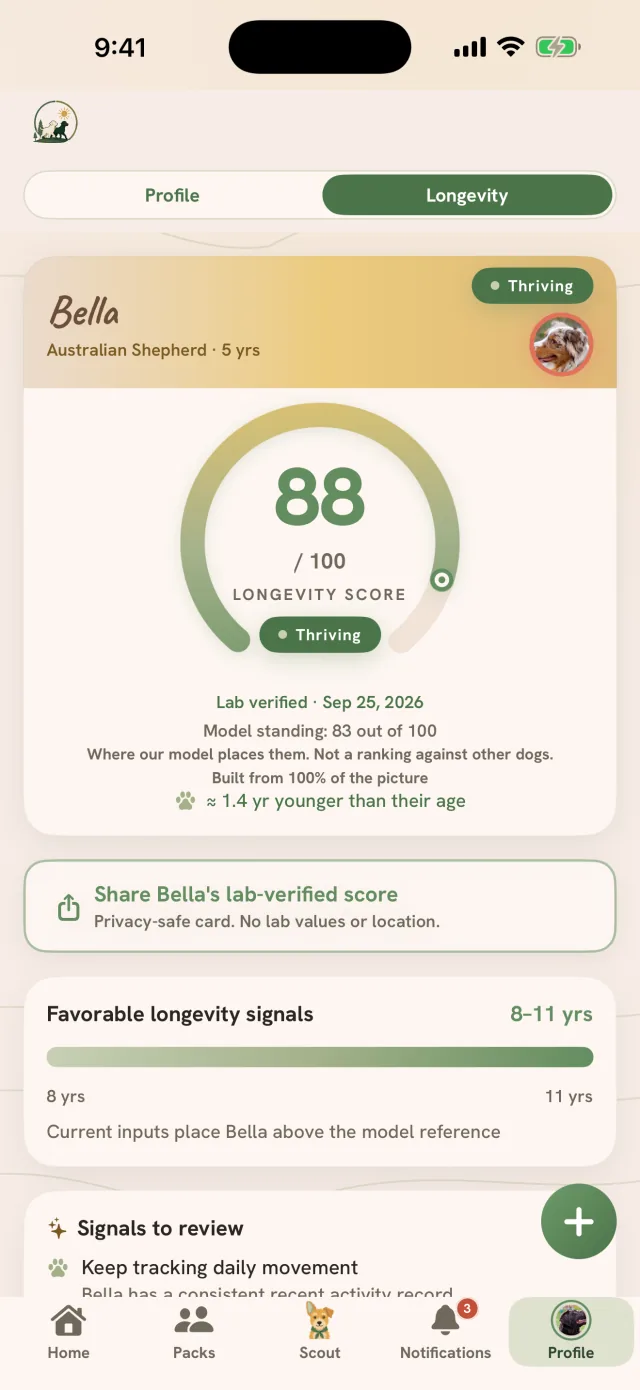
Longevity scoreLab verified
82/ 100Longevity scoreGreat

Model standing: 72 out of 100

Where our model places them. Not a ranking against other dogs.

Modeled remaining-life range7.612.2 yrs

An unvalidated model interval, never a death date or healthspan claim.

Bio-age 0.8 yr younger96% complete

Illustrative Lab-verified sample. Every value here is placeholder data. Your dog’s comes from your vet.

The range narrows

With a real panel in hand, the heuristic model interval can change as completeness increases. It remains uncalibrated and is never a death date or healthspan claim.

A bio-age delta you can track

Where the model places your dog against their calendar age, size-adjusted: here, 0.8 years younger than the birthday says. Rerun a panel and watch it move; it is not a measurement of your dog's biology.

Signals to review

The model can surface body-condition and activity signals for discussion. It does not estimate how many years changing either signal would add.

A read your vet can act on

The seven dimensions give your vet more context for follow-up. Your owner view shows the deterministic score and any notes your veterinarian chooses to share; Tailmates does not auto-suggest supplements.

Questions, answered

Straight answers about bloodwork

Is the bloodwork read a diagnosis?
No. It's owner-facing decision support, not a medical test or a diagnosis. Every number on this page is a sample. Your dog's real results come from your vet's panel, and only your veterinarian can interpret them, diagnose your dog, or recommend any treatment.
Why does bloodwork stay locked until my vet reviews it?
Because a lab-verified score has to mean something. The fourth bar unlocks after a licensed vet reviews the panel, attests the values match the source lab report, and confirms a VCPR. Your vet reviews the panel, the lab validates the data, and no app activity can unlock a lab-verified score without that review.
What do I actually get once bloodwork is unlocked?
The fourth bar fills in, the healthy-years range narrows because there's more to go on, and you get a bio-age delta you can track over time. You can follow the deterministic score and health bars alongside any notes your veterinarian chooses to share.
Do I need special bloodwork, or does my normal panel work?
A standard chemistry panel and CBC, the kind of wellness bloodwork many dogs already get, reports most of these markers, including SDMA on modern panels. The more of the picture that's present, the tighter the range, and every score shows how much of the picture it was built from. Below a minimum completeness we refuse a headline number rather than guess.
Does Tailmates sell supplements?
No. We don't sell supplements, treatments, or cures. Tailmates' fee covers the longevity analysis only, and your vet stays in the loop for the medicine, billing you for the visit, draw, and lab at their own rates.

Please read

The short version: Tailmates is a wellness and fitness product, not a medical device and not a veterinary provider. The bloodwork reads on this page are educational and non-diagnostic sample previews: illustrative, not real results. The longevity score is expressed as a range, never a single date, and it does not diagnose, treat, cure, or prevent any disease. Your dog’s real results, and any recommendation, come from your licensed veterinarian.

If your dog is unwell, contact a veterinarian or an emergency clinic. Do not wait on, or rely on, an app score.

Read your dog’s inside story.

Start free, review with your vet

The Estimate unlocks the moment you add your dog. Add a blood panel whenever you’re ready, and let your vet review it so Tailmates can compute a lab-verified score.